
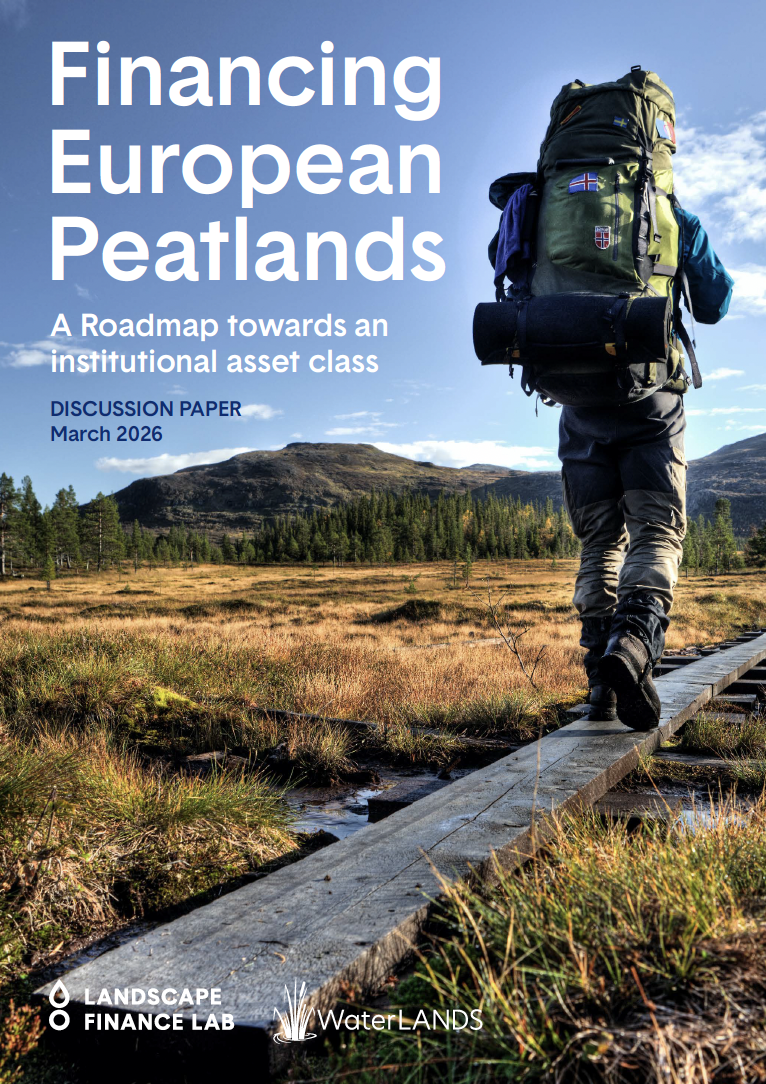
Financing European Peatlands: A Roadmap towards an institutional asset class
Spanning approximately 6% of its landmass, Europe’s peatlands represent one of the continents most powerful – and most neglected – nature-based solutions. This report presents a clear path for transforming peatland restoration finance from grant-dependent, individual projects into a genuine, natural infrastructure-like asset class, unlocking billions in private capital and delivering climate mitigation, water security and nature recovery for decades to come.
The potential impact of peatland restoration is substantial. On a conservative basis, 1.1 million hectares of peatlands across eight key European ‘peatland archetypes’ in the UK, Ireland, the Netherlands, Germany, Poland and Scandinavia are feasibly restorable over the next decade alone, reducing emissions by over 300 MtCO₂e over project lifetimes. This is equivalent to permanently removing approximately 1.3 million passenger cars from Europe’s roads. Beyond carbon, restored peatlands generate material water benefits for utilities and communities, enhance biodiversity, and enable new forms of productive land use.
The economics of peatland restoration are not a fundamental barrier to private investment with some peatland restoration already demonstrating investible economics today. Yet despite the strong fundamentals, private investment has remained elusive due to fragmented markets, small project sizes, and weak revenue certainty.
This report charts a clear path forward. By diversifying and stabilising revenues across carbon, water, and biodiversity markets, aggregating projects into investible portfolios, and adopting project-finance structures familiar to infrastructure investors, Europe can unlock the billions in private capital needed for peatland restoration at scale.
What this report covers:
- Section A outlines the possible positive ecological impacts and investment opportunities of restoring European peatlands, including analysis of the carbon, water, biodiversity and productive land use benefits, as well as the investment potential of restoring European peatlands.
- Section B showcases the case for peatland restoration as an asset class, including insights into the financing landscape of peatlands today, possible returns for peatland restoration, deep dives into the carbon, water and biodiversity markets in relation peatland restoration and what investment risks and market restraints remain.
- Section C provides multiple roadmaps with practical recommendations and suggested timelines to address three market or system-level shifts that would unlock more private finance for peatland restoration. There are roadmaps for five key stakeholder groups: standard setters and stewards of voluntary markets, buyers of ecosystem services, public agencies and government, project developers, investors, asset managers and other financial intermediaries.
How was this report developed:
This report builds upon the Landscape Finance Lab’s substantial involvement in European Peatlands since 2016, including facilitating a UK & Ireland Peatland Finance Community of Practice, incubating Peatland Finance Ireland and the Flow Country Partnership's Green Finance Initiative, and supporting the Great North Bog landscape as part of the EU Horizon WaterLANDS project. This paper also develops in greater depth some of the themes originally explored in the Lab’s 2023 publication ‘Investing in Peatlands'.
It has researched the economics of peatland restoration via a literature review, selected interviews with key market participants, and original research leading to the creation of a bespoke dataset of 400+ European peatland projects. Key findings are illustrated in tables throughout the report, with all sources described in the Annex. Findings are then used as inputs into simple cashflow models to test how close peatland restoration already is to an investible proposition.

How to make the most of this report:
Our aim is to use this report to help turn this discussion on financing peatland restoration into clear actions. Below are some ways to be part of the action:
- Read, share and use this report. If you’re one of our five key stakeholder groups – standards-setters, corporate buyers, developers, investors, governments – read your relevant roadmap in Section C, test the analysis, help refine the solutions, and consider where your own institution can play a practical role in building this market.
- Join the Roadmap Action Group. We will be consulting on the formation of a Roadmap Action Group to take forward the most practical priorities: building the project pipeline, improving investability, developing revenue models, strengthening market infrastructure, and aligning public, private and philanthropic actors. Email deesha@landscapelab.org if you'd like to be involved.
- Sign up to our newsletter and stay up to date with news from the Roadmap Action Group and the Lab. We are planning an upcoming joint event with the European Investment Bank that will specifically update stakeholders on the Roadmap Action Group and implementation efforts.
Watch the launch event:
Acknowledgements
We extend our thanks to all contributors, reviewers and interviewees whose insights helped to shaped this paper. The report was made possible with funding support from the EU Horizon WaterLANDS project. We also acknowledge the support of the Landscape Finance Lab's core funders RELEX Foundation for a Better Future and alv Foundation.
The report has been developed as a contribution to the resource mobilisation target of the Peatland Breakthrough. The Peatland Breakthrough is a global call to action led by Wetlands International, the United Nations Environment Programme, the Food and Agriculture Organization of the United Nations, the Greifswald Mire Centre, developed in close alignment with the Global Peatlands Initiative, and in collaboration with the Convention on Wetlands and the Marrakech Partnership.
The report is supported by the European Investment Bank and the Global Peatlands Initiative.