
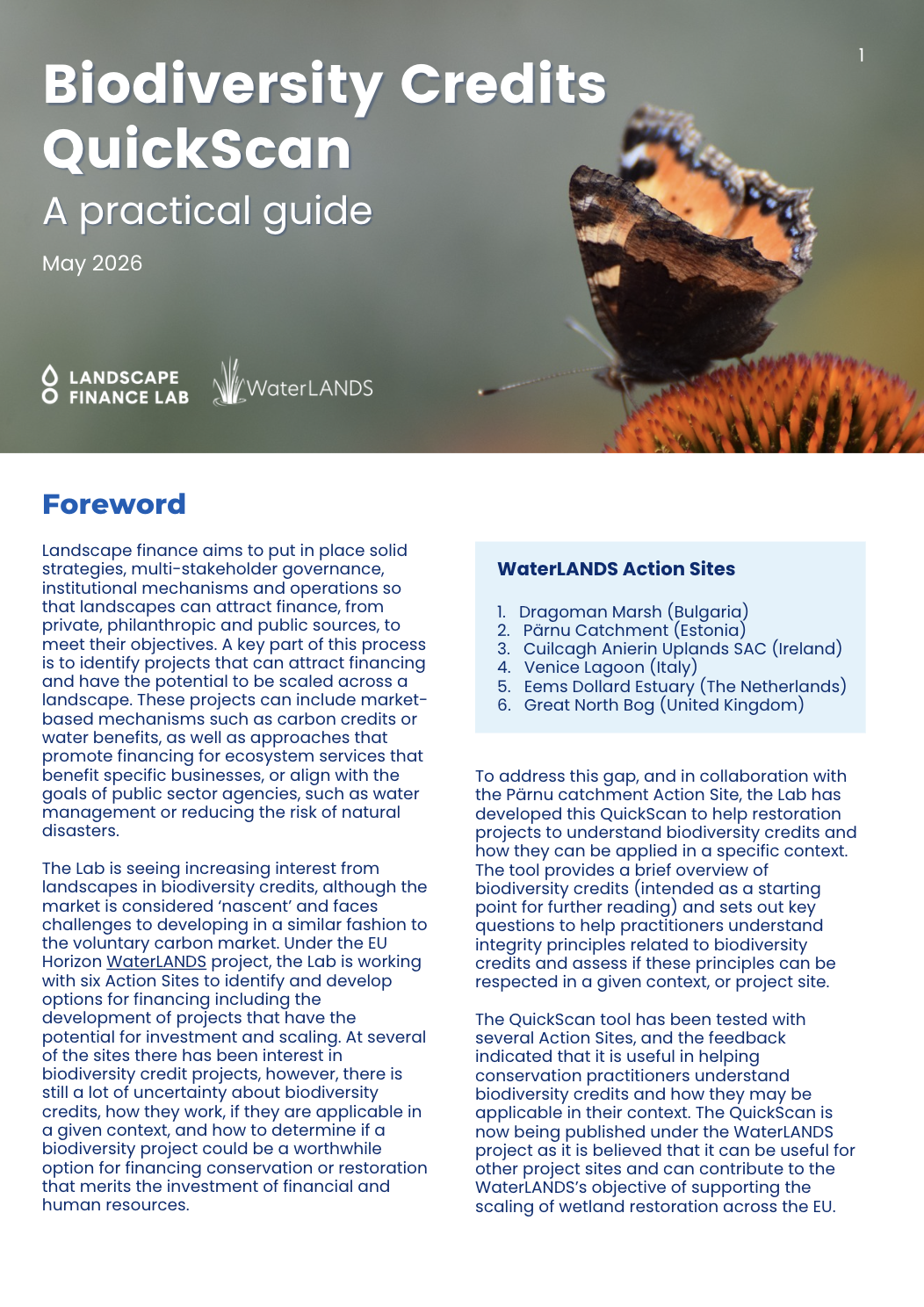
Under the EU Horizon WaterLANDS project, the Lab is working with six Action Sites to identify and develop options for financing, including the development of projects that have the potential for investment and scaling. At several of the sites there has been interest in biodiversity credit projects, however, there is still a lot of uncertainty about biodiversity credits, how they work, if they are applicable in a given context, and how to determine if a biodiversity project could be a worthwhile option for financing conservation or restoration that merits the investment of financial and human resources.
To address this gap, and in collaboration with the Pärnu Catchment Action Site, the Lab has developed this QuickScan to help restoration projects to understand biodiversity credits and how they can be applied in a specific context. The tool provides a brief overview of biodiversity credits (intended as a starting point for further reading) and sets out key questions to help practitioners understand integrity principles related to biodiversity credits and assess if these principles can be respected in a given context, or project site.
Download the QuickScan tool template
The QuickScan is intended as a self-assessment tool for implementing organisations, landscape practitioners or land managers, to help them get an early indication of the potential to carry out a biodiversity credit project. By highlighting key feasibility indicators and considerations, QuickScan questions will draw attention to potential barriers and gaps (orange or red answers), and can serve as a basis for prioritising the next stage of scoping, research and project development. There is no formal scoring system or metric to evaluate total results. Instead, users are encouraged to use their own discretion to reflect on whether potential issues flagged by the tool can be addressed to improve overall feasibility.
The QuickScan has been tested with several Action Sites, and the feedback indicated that it is useful in helping conservation practitioners understand biodiversity credits and how they may be applicable in their context. The QuickScan is now being published under the WaterLANDS project as it is believed that it can be useful for other project sites and can contribute to the WaterLANDS’s objective of supporting the scaling of wetland restoration across the EU.