
Landscape GHG Accounting Guidance: Developing landscape-scale carbon projects
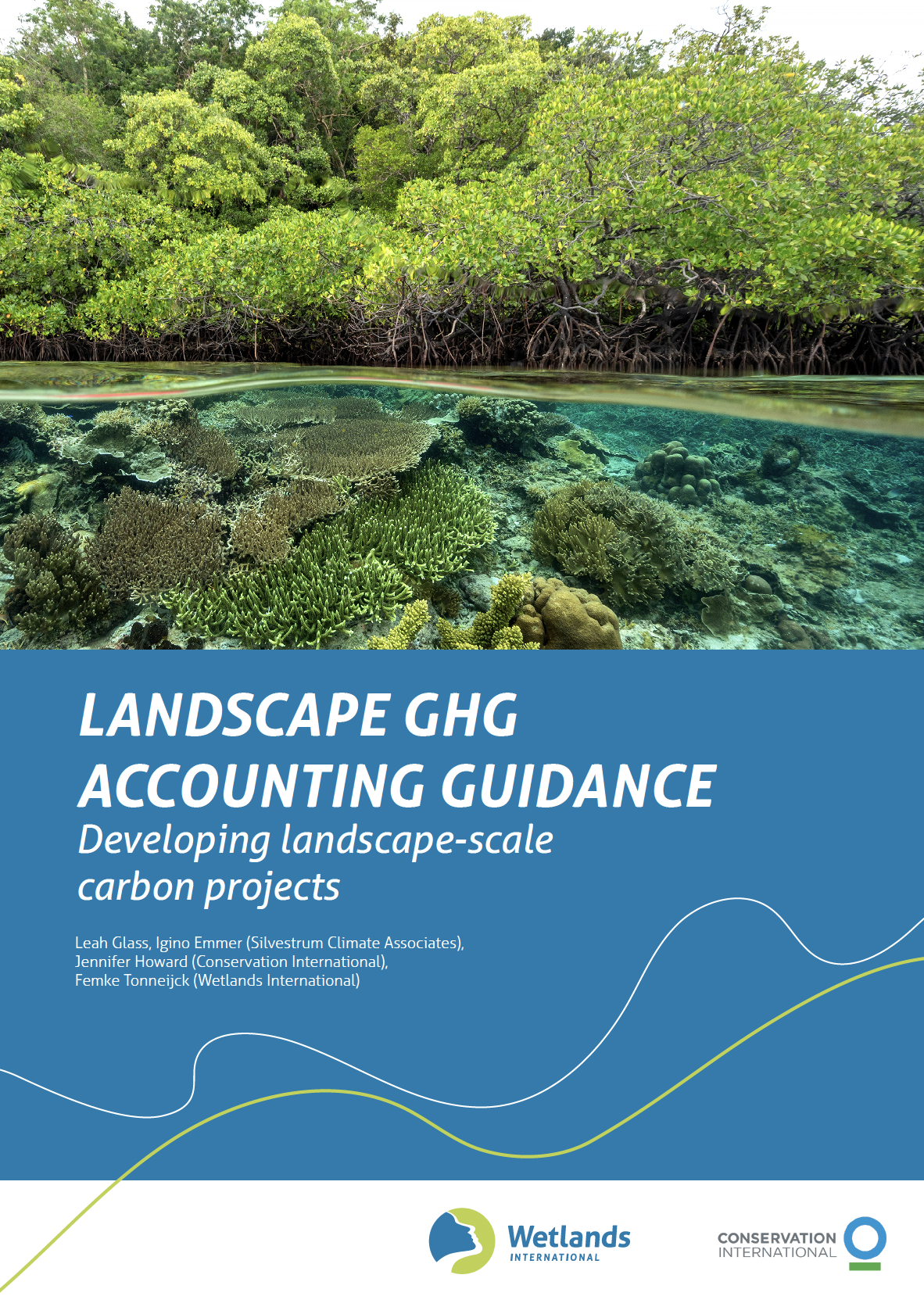
The complexity associated with developing carbon projects at a landscape scale has been a major barrier to investment and implementation. To help overcome this barrier, this brief provides project developers with pragmatic guidance regarding how to implement one of the voluntary carbon standards, the Verified Carbon Standard (VCS), at a landscape level, focusing on the greenhouse gas accounting component.
This brief by written by Silvestrum Climate Associates, and commissioned by Wetlands International and Conservation International in association with Commonland and the Landscape Finance Lab discusses a critical decision in developing carbon projects for landscape-scale initiatives: whether to include multiple activities within a single project document (PD) or to create multiple PDs for different activities within a landscape. Option 1, a single PD, may be preferable as landscape-scale initiatives should be developed under a single, holistic vision and strategy. However, in the context of a VCS carbon project, several key considerations arise, including:
- Project ownership: Establishing clear legal ownership of carbon rights and project proponents.
- Project costs and investment: Different ecosystems, activities, and carbon credit types may attract different levels of investment interest or credit price.
- Timing: VCS Program requirements and deadlines, as well as differing start dates and implementation timelines for activities across a landscape, can impact financial flows.
- Ecosystem connectivity: Including multiple ecosystems and activities within one PD may simplify the development of a holistic theory of change across the landscape and allow for quantifying GHG impacts across multiple ecosystems within the carbon accounting framework.
Efficiencies for carbon projects in landscape-scale initiatives, regardless of the chosen option, include:
- Similarity in data types or analysis needed for setting baseline scenarios and/or monitoring.
- Reduced leakage due to the management of adjacent ecosystems.
- Taking ecosystem connectivity into account in the development of a theory of change and approach to carbon benefit quantification.
- More comprehensive stakeholder engagement and view of community impacts and benefits.
Landscape-scale projects have the potential to safeguard nature by preserving ecological connectivity between different ecosystems and maximizing the social and financial returns of sustainable resource management. Understanding how each component of a VCS project can be conceptualised at a landscape scale enables project developers to leverage the inherent integrated framework of a landscape-scale project to maximize both the efficiency and level of investment of any climate finance component.